2026 Legal Reconditioning: The Essential Impact of the 2025 Criminal Procedure Code for the Business Sector
According to Law No. 8 of 1981 concerning the Criminal Procedure Code (“Old KUHAP”), regulations concerning the investigation and examination of criminal acts are basically structured on the assumption that the subject of criminal law is an individual. As a result, all aspects specifically related to the investigation and examination of corporations, including the procedures for summoning, examining, applying coercive measures, and determining the parties representing and responsible for them, are not explicitly regulated. This regulatory has led to legal uncertainty in the practice of law enforcement against corporations. In contrast, Law No. 20 of 2025 concerning the Criminal Procedure Code (“KUHAP 2025”) provides more comprehensive and systematic regulations that specifically accommodate the characteristics of corporations as subjects of criminal law, with the following scope of regulations:
| Issue | Old KUHAP | KUHAP 2025 |
|---|---|---|
| Corporate Summons | Not regulated | Article 193 paragraphs (7) and (8) concerning the summons of Defendants that are Corporations. |
| Corporation | Not regulated | Chapter XVIII on Corporations. |
| Corporate Responsibility | Not regulated | Article 326: Corporate liability and responsible parties. |
| Summons of a corporation | Not regulated | Article 327 on investigation and inquiry, in the case of summons, examination, provisions on coercive measures, restorative justice. |
| Liability in the event of a merger, consolidation, division, or dissolution of a corporation | Not regulated | Article 330 concerning Corporations may still be held liable in the event of a merger, consolidation, separation, or dissolution, with the procedures further regulated in a Government Regulation. |
| Deferred Prosecution Agreement | Not Regulated | Article 328 regulates Deferred Prosecution Agreements. |
In this context, Article 326 of the 2025 Criminal Procedure Code emphasizes that criminal liability is not only imposed on corporations as legal entities, but also on those responsible for the corporation, including executives with functional positions, those who give orders, those in control, and beneficial owners. With this arrangement, the scope of responsibility becomes broader because individuals who play a role in decision-making or who derive benefits can also be held accountable.
Deferred Prosecution Agreement/DPA
One of the important updates in the 2025 Criminal Procedure Code is the introduction of a Deferred Prosecution Agreement (“DPA”), as stipulated in Article 328 of the 2025 Criminal Procedure Code. This agreement is essentially a mechanism between the Public Prosecutor and corporate offenders that can suspend prosecution for a certain period of time so that at the same time the corporation fulfills its agreed obligations. This mechanism aims to encourage legal compliance, recovery of losses, and increase efficiency in the criminal justice process. Therefore, if a DPA request is accepted, the court will assess the feasibility and validity of the agreement through a review hearing.
The terms and conditions in the DPA may include compensation payments, implementation of compliance programs or corporate governance improvements, as well as reporting obligations and cooperation with law enforcement agencies. If the suspect or defendant fulfills all of these obligations within the specified time frame, the case may be dismissed without further prosecution based on a court ruling. The court also has the authority to monitor the implementation of the agreement.
However, if the obligations in the agreement are not fulfilled, the Public Prosecutor may continue the prosecution without requiring additional approval. Each agreement is officially recorded and submitted to the judge to be recorded in the minutes. Violations of the agreement procedure may result in legal nullity and become the basis for the suspect or defendant to file an objection or resistance. With the introduction of the DPA, the 2025 Criminal Procedure Code presents a new solution in the enforcement of corporate criminal law that is oriented towards recovery, compliance, and the prevention of repeat offenses. The following is an outline of the Prosecution Agreement as stipulated in the 2025 Criminal Procedure Code:
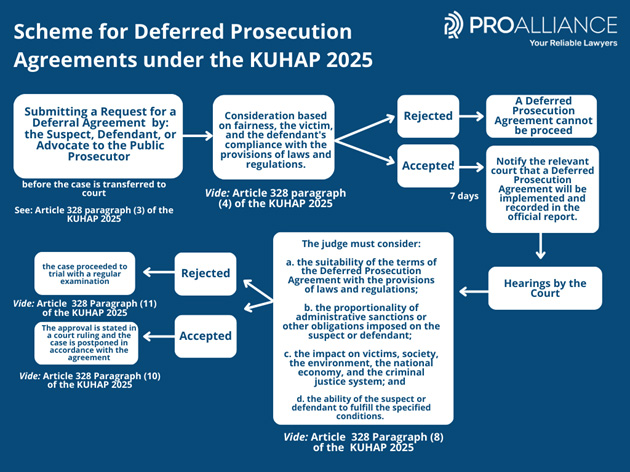
In the process, the submission of a DPA involves a judge who also considers aspects related to the approval of the DPA submission. The judge considers the suitability of the conditions in the DPA, the proportionality of administrative sanctions or other obligations of the suspect/defendant, the impact on the victim, and the suspect’s ability to meet the specified conditions. The DPA mechanism is expected to be a new solution for handling corporate crimes by a corporation that is more effective and in line with the Ultimum Remedium principle, which makes criminal law a last resort.
Conclusion
The enactment of the 2025 Criminal Procedure Code in 2026 will bring fundamental changes to criminal law in Indonesia, particularly in the context of handling criminal cases involving corporations. One important update is the introduction of the DPA mechanism, which opens up the possibility of resolving cases outside of the conventional judicial process by focusing on recovery of losses, improvement of governance, and increased corporate compliance with applicable legal provisions. This approach reflects a paradigm shift from solely criminal punishment to a more proportional and preventive model of law enforcement, without neglecting corporate accountability. However, the existence of DPAs does not necessarily reduce legal risks for corporations, as this mechanism still requires acknowledgment of violations, fulfillment of certain obligations, and strict supervision by law enforcement officials. Therefore, corporations are required to proactively strengthen their compliance systems, good corporate governance, and effective internal oversight to ensure readiness to face an increasingly structured, transparent, and strict criminal law enforcement regime.
If you need assistance in reviewing the implications of the latest regulations and your corporation requires guidance in developing appropriate compliance measures, please do not hesitate to contact our Professional Lawyer, Rizky Putra Pratama (mail to: [email protected]). We will be happy to assist you.
We would also like to express our gratitude and welcome our new Trainee Lawyers, Geby, Hutomo, and Bianca, who have diligently researched related issues and contributed to this article as part of their ongoing contribution to the firm.